Environment & Waste Management in Mining: From Monitoring to Digital Integration
The growing importance of environmental protection and sustainable resource management has placed increasing pressure on the mining sector to adopt advanced technological solutions. This article focuses on the “MINE.IO Final Event Workshop – Demonstration III: Environment & Waste Management” session, illustrating how environmental monitoring, waste management, and digital transformation can be integrated into a coherent operational framework, bridging the gap between data acquisition and real-time decision-making within mining environments.
Environmental challenges and the need for new approaches
Mining activities remain essential for supplying raw materials required for energy, infrastructure, and advanced technologies. At the same time, they are associated with significant environmental challenges, including land degradation, waste generation, and contamination risks.
Tailings facilities, waste repositories, and legacy mining sites represent complex environments where traditional monitoring approaches are often insufficient. Limited visibility, fragmented data sources, and delayed decision-making processes contribute to inefficiencies and increased environmental risks.
To address these issues, the Mine.io framework combines advanced sensing technologies, data processing capabilities, and digital platforms, enabling a transition from static monitoring towards dynamic, data-driven environmental management.
Pilot-based validation in real mining environments
During the project, the developed technological framework was validated through pilot implementations in two contrasting mining environments: Lavrion in Greece and Pyhäsalmi in Finland, and was presented during the Demonstration and Exhibition sessions of the final event.
In Lavrion, the focus was placed on waste repositories and complex mining structures, including both surface and underground environments. The first pilot case addressed polluted soil repositories, where multiple sensing technologies were deployed to characterize and monitor waste structures.
The second pilot focused on an underground hazardous waste repository (UHWR), a controlled environment designed for storing industrial waste. This setting enabled the testing of advanced sensing technologies under realistic conditions, while ensuring safety and containment.
In Pyhäsalmi, the emphasis shifted towards tailings facilities, where geophysical monitoring and data integration were used to assess structural stability and environmental impact. The combination of different pilot contexts demonstrated how the Mine.io approach was adapted to a wide range of mining scenarios.
Advanced sensing and geotechnologies for environmental monitoring
A core component of the Mine.io approach was the deployment of advanced geotechnologies for environmental characterization and monitoring.
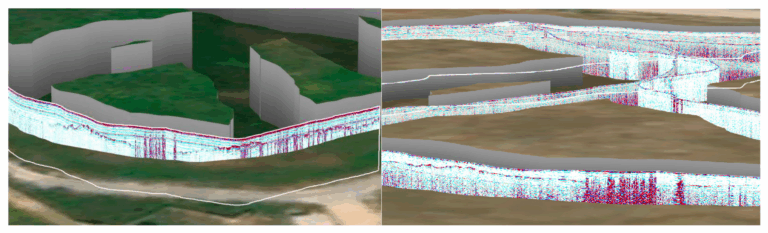
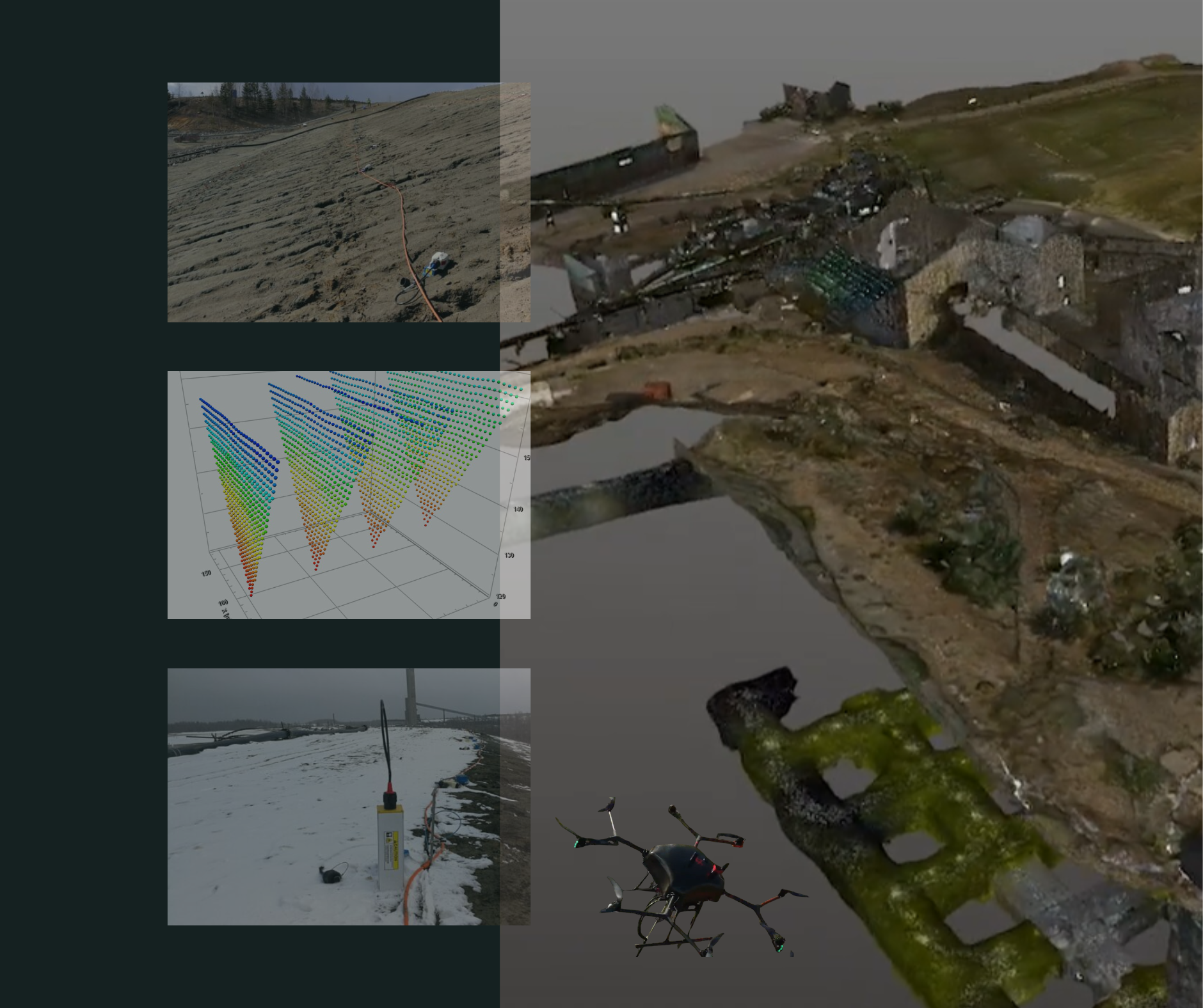
These included drone-based magnetometry, ground penetrating radar (GPR), electrical resistivity imaging, and seismic interferometry, each providing complementary insights into subsurface structures.
In addition, LiDARSLAM systems enabled high-resolution 3D mapping of mining environments, while InSAR satellite monitoring provided large-scale analysis of ground movements and subsidence.
IoT-based monitoring solutions, implemented through LoRaWAN networks, allowed continuous real-time observation of subsurface parameters, supporting early detection of anomalies and improved operational awareness.
Together, these technologies formed a multi-layer sensing framework, capable of capturing both local and large-scale environmental dynamics.
An example of the sensing and geophysical monitoring technologies applied in the Lavrion pilot is presented in the video below.
Data processing and modelling: from measurements to insight
The integration of heterogeneous sensor data required advanced data processing and modelling capabilities.
Within the Mine.io framework, dedicated data acquisition systems (DAQ) enabled the collection and transmission of geophysical data to cloud-based platforms.
Subsequently, raw measurements were transformed into interpretable models through defined data processing workflows, including electrical resistivity distributions, seismic velocity maps, and hydrogeological models.
Multi-source data fusion played a central role in combining different datasets into coherent representations of mining environments. This enabled more accurate assessments and supported decision-making processes at both operational and strategic levels.
Muon-based sensing for underground analysis
In the context of underground monitoring, muon-based sensing introduced an additional layer of analysis.
Muon telescopes measured the flux of naturally occurring cosmic particles, which varied depending on the density of the material above the detector.
By analysing these variations, it was possible to reconstruct density models of the subsurface environment, providing insights into otherwise inaccessible structures.
This non-invasive approach complemented traditional geophysical methods, particularly in environments where direct measurement was difficult or impossible.
Blockchain for traceability and data governance
Beyond sensing and modelling, the Mine.io framework incorporated blockchain technology to address challenges related to data management, traceability, and trust.
The system was based on a distributed network architecture using Hyperledger Besu, combined with off-chain storage mechanisms such as IPFS for handling large datasets and sensitive information.
Blockchain enabled the traceability of mining assets and processes, ensuring transparency across the value chain, from raw materials to waste management.
By providing immutable records and supporting smart contracts, the technology strengthens, reduces, and facilitates governance and collaboration between stakeholders.
Work Flow Automation Engine: operational process management
Complementing blockchain, the Work Flow Automation Engine was applied as part of the project, enabling a more structured approach to managing operational processes.
Based on BPMN 2.0 standards, the system was developed within the project as a workflow framework and is based on BPMN 2.0, which supports improving real-world process modelling and simulation across mining operations.
The solution presented during the session supports the automation of business processes, including work order management, validation procedures, and agreement handling.
The integration of analytics tools supports the identification of bottlenecks and continuous process optimisation, while ensuring traceability of decisions and actions.
With this approach, the presented layer provides the capability to transform data and insights into concrete operational workflows, bridging the gap between analysis and execution.
More on the Work Flow Automation Engine developed within the Mine.io project can be found in the article below, which explores how the solution supports process orchestration, automation, and integration of operational workflows in mining environments.
WebGIS and system integration: from data to interaction
The integration of technologies was achieved through the Mine.io platform, where the WebGIS Viewer served as one of the user interface components.
The system enabled the integration of data from multiple sources, allowing satellite imagery, UAV data, sensor measurements, and geophysical models to be combined into a unified environment.
This allowed users to explore three-dimensional representations of mining sites, access real-time data, and interact with different pilot scenarios through a map-based interface.
The platform also enabled data export and provided tools for generating actionable insights, supporting both operational decision-making and strategic planning.
During the Demonstration and Exhibition sessions, it was shown how this approach enabled users to navigate between pilot sites, analyse environmental conditions, and work with integrated datasets in real time.
From monitoring to digital mining intelligence
The combined use of sensing technologies, data processing, and digital infrastructure enabled a transition towards a new paradigm of mining operations.
Instead of isolated systems and delayed analysis, the Mine.io approach created an integrated environment where data flowed continuously from sensors to decision-making tools.
This resulted in improved situational awareness, enhanced safety, and more efficient resource management.
Through the integration of environmental monitoring and waste management with the digital layer, the developed platform and the technologies presented during the session support the principles of circular economy and sustainable mining.
Conclusion
The Mine.io approach demonstrated how advanced technologies were combined into a comprehensive system for environmental monitoring and waste management in mining.
By integrating sensing, modelling, blockchain, workflow automation, and interactive platforms, the project moved beyond theoretical solutions and delivered practical, validated tools for real-world applications.
This integrated framework provided a foundation for safer, more transparent, and more sustainable mining operations, supporting the broader transition towards Mining 4.0.
Implementation and technological contribution
The presented solutions were developed and validated within the pilot activities by the following partners, who combined their expertise in sensing technologies, geophysical monitoring, data processing, and digital platforms, including WebGIS-based data integration, Work Flow Automation Engine, blockchain-based traceability mechanisms, etc.
▫️ Lavrion Technological and Cultural Park (AMDC)
▫️ Universidad de Salamanca (USAL)
▫️ ACCELIGENCE LTD (ACC)
▫️ Fundación Tecnalia Research & Innovation (TEC)
▫️ Frontier Innovation (FRON)
▫️ University of Oulu (OULU)
Watch the Session & Explore Materials
If you were not present at our final event, you can watch the full recording of the Pilot Demonstration III session here:
🎥 Final Event Recap: Session 4 | Pilot Demonstrators III – Environment & Waste Management https://youtu.be/0zkdmPkcfSg
Next in the Series
In the upcoming articles, we will focus on the Scaling, Impact, and Market Readiness aspects of the Mine.io project, covering:
- Social Sustainability of Digital Transformation in Mining,
- Standardisation Perspective, and
- Market Analysis & Exploitation.
These publications will explore how the technologies developed within Mine.io translate into broader industrial, social, and market contexts, addressing their impact, scalability, and pathways towards real-world deployment.