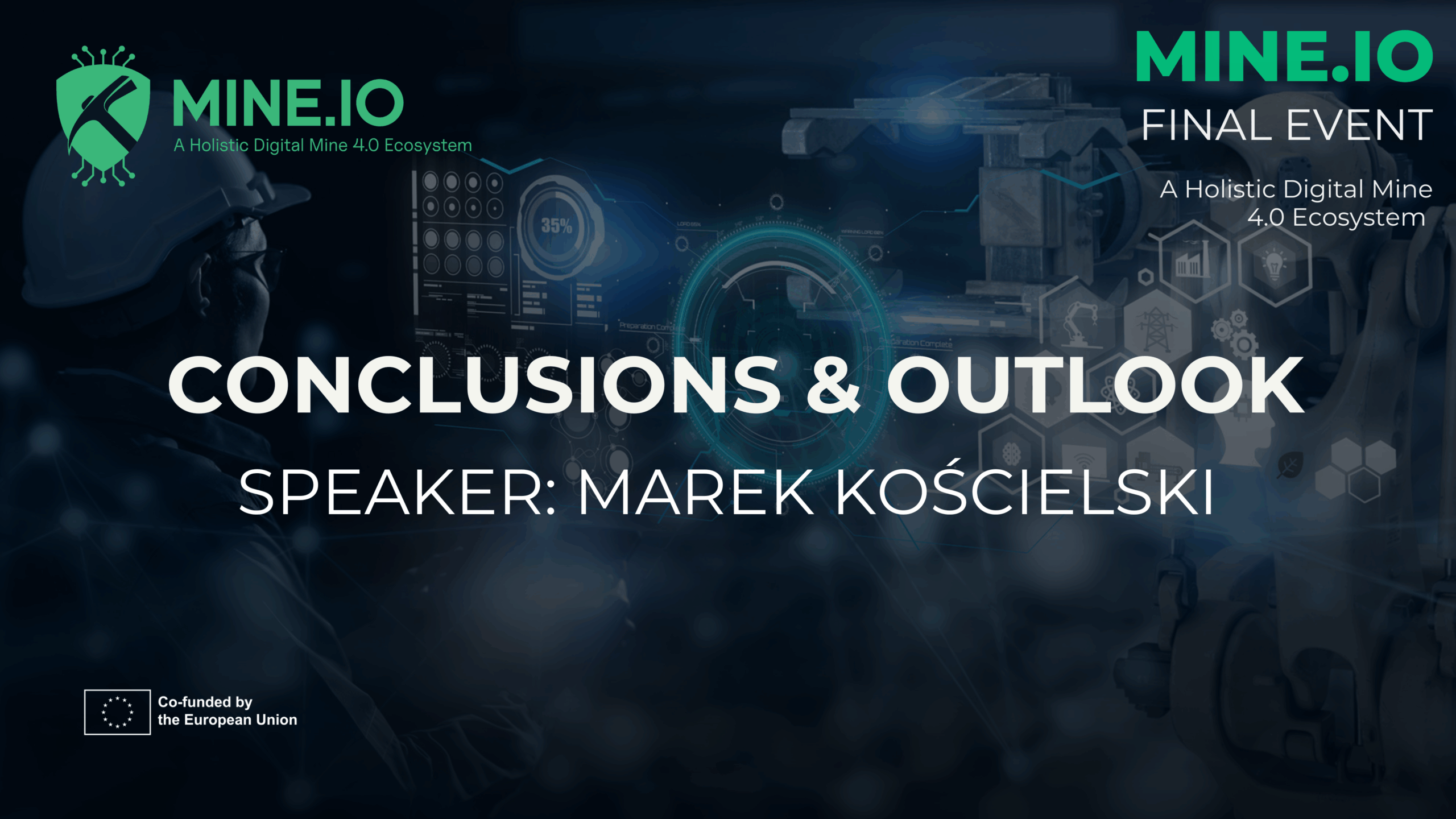
Mine.io Final Event Recap – Conclusions & Outlook: Challenges and Opportunities Beyond the Project
From Project Results to Real-World Impact
The final session of the Mine.io Final Event brought together project partners, industry representatives, researchers and innovation experts for an open discussion on one of the most important questions facing the mining sector today:
How can innovative digital solutions move beyond research projects and become part of everyday mining operations?
Over the course of the Final Event, participants explored the Mine.io Digital Architecture, AI-driven solutions, autonomous and electrified operations, environmental monitoring technologies, social sustainability assessment methods, standardisation activities and market exploitation strategies. Together, these sessions demonstrated how digital technologies can support the transition towards a more efficient, sustainable and integrated mining sector.
The concluding discussion shifted the focus from technologies themselves to the broader challenges that will determine whether these innovations can successfully create impact beyond the lifetime of the project.
The Human Side of Digital Transformation
One of the first topics raised by the participants was the growing challenge of attracting young people to the mining sector. Although modern mining increasingly relies on advanced technologies, automation, artificial intelligence and digital tools, the industry still struggles with a public perception problem. As one participant noted during the discussion, mining is often not considered an attractive career path by younger generations.
Representatives from academia confirmed that mining-related study programmes are experiencing a significant decline in student numbers compared to previous decades. At the same time, the demand for skilled professionals capable of working with advanced technologies continues to increase.
Several speakers emphasised that addressing this challenge requires long-term efforts. Better communication about the role of mining in supporting modern society, renewable energy technologies and digital transformation will be essential. Participants also highlighted the importance of engaging with schools and universities at an early stage to help younger generations better understand the importance of responsible and sustainable mining.
An interesting observation emerged during the discussion: projects such as Mine.io and DynamiNE may help change the perception of the sector by demonstrating that mining today involves cutting-edge digital technologies, innovation and sustainability rather than traditional stereotypes associated with the industry.
From Innovation to Commercialisation
Another major discussion topic focused on the well-known gap between research and market deployment.
Participants agreed that moving technologies from research projects to commercial applications remains one of the greatest challenges for innovation ecosystems. While projects such as Mine.io successfully demonstrate advanced concepts and validate them through pilot implementations, additional work is often required before solutions become fully market-ready.
Several speakers pointed out that technology maturity remains a key factor. Although many project results show considerable promise, further development, testing and industrial validation may be necessary before large-scale deployment becomes possible. This challenge is recognised even at the European level, where post-project exploitation activities are expected to continue beyond the official lifetime of Horizon Europe projects.
The discussion repeatedly highlighted the importance of partnerships between research organisations, technology providers and mining companies. Such collaborations can help bridge the gap between innovation and real-world implementation while also ensuring that future developments address actual industry needs.
Demonstrators as a Bridge to Industry
The role of pilot sites and demonstrators emerged as another key theme of the discussion.
Participants stressed that demonstration facilities provide a practical environment where innovations can be tested, validated and refined before being introduced into industrial operations. Demonstrators not only help researchers improve technical performance but also allow industry stakeholders to better understand the value and potential of new technologies.
Examples discussed during the session included predictive maintenance systems, process optimisation tools, autonomous systems and electrification technologies presented throughout the Final Event. These solutions illustrate how pilot environments can reduce adoption risks and provide evidence of technological and economic benefits.
The discussion suggested that demonstrators play a particularly important role in building confidence among industrial stakeholders, investors and decision-makers who need evidence before committing to large-scale implementation.
Is the Mining Industry Ready?
One of the most interesting questions raised during the discussion concerned the readiness of the European mining industry to adopt digital innovations.
Industry representatives explained that mining companies are generally open to innovation but must balance innovation ambitions with operational realities. Production, safety and reliability remain top priorities. As a result, introducing new technologies into active mining operations requires extensive testing, validation and certification.
Participants noted that mining environments are often harsh and demanding. Technologies that perform well in laboratory conditions may require substantial adaptation before they can operate reliably underground or in large-scale industrial environments. For this reason, many mining operators prefer proven and robust solutions over technologies that are still perceived as experimental.
At the same time, the discussion demonstrated that there is genuine interest from industry in adopting innovations that improve safety, productivity and operational efficiency. The challenge is not a lack of interest, but rather ensuring that technologies are mature enough to meet industrial requirements.
Building Strong Business Cases
A recurring conclusion throughout the discussion was that technological innovation alone is not sufficient.
For successful market uptake, new solutions must demonstrate clear and measurable benefits. Participants highlighted several examples from Mine.io and related projects where digital technologies can improve operational efficiency, reduce downtime, enhance safety and optimise resource utilisation.
Predictive maintenance was discussed as a particularly strong example of a technology capable of delivering direct economic value. By analysing operational data and identifying potential failures before they occur, such systems can reduce maintenance costs and minimise production interruptions.
Similarly, autonomous operations, electrification technologies and advanced process optimisation solutions were cited as examples where innovation can generate tangible business benefits while also contributing to sustainability goals. According to participants, demonstrating these benefits through credible business cases will be critical for future adoption.
Looking Ahead
As the discussion came to a close, participants agreed that the digital transformation of mining is not a single technological step but a long-term process requiring collaboration, investment and continuous innovation.
The technologies developed within Mine.io demonstrate considerable potential, but their long-term success will depend on education, industry engagement, continued research and the effective implementation and adaptation of the exploitation pathways and market deployment strategies already identified within the project.
The discussion also highlighted that the future of mining will depend not only on technological excellence but also on society’s ability to attract skilled professionals, support innovation and recognise the critical role of raw materials in the green and digital transition.
Thank You for Following the Mine.io Final Event Series
The Conclusions & Outlook session marked the final chapter of the Mine.io Final Event Workshop Recap series.
Throughout this series, we explored the Mine.io Digital Architecture, Smart & Automated Operations, Autonomous & Electrified Operations, Environment & Waste Management, Social Sustainability, Standardisation and Market Exploitation. Together, these sessions showcased how Mine.io has contributed to advancing the vision of a digitally integrated, sustainable and resilient mining ecosystem.
We would like to thank all project partners, speakers, stakeholders and participants who contributed to the success of both the Mine.io project and its Final Event.
Watch the Session & Explore More
🎥 Final Event Recap: Session 8 | Conclusions & Outlook – Open Discussion
We invite you to watch the full recording of the session and revisit the discussion on the future of digital mining.
We also encourage you to explore the previous articles and webinar recordings from the Mine.io Final Event series to learn more about the project’s technologies, pilot demonstrations and key achievements.
📖 𝗘𝘅𝗽𝗹𝗼𝗿𝗲 𝘁𝗵𝗲 𝗰𝗼𝗺𝗽𝗹𝗲𝘁𝗲 𝗙𝗶𝗻𝗮𝗹 𝗘𝘃𝗲𝗻𝘁 𝗪𝗼𝗿𝗸𝘀𝗵𝗼𝗽 𝗥𝗲𝗰𝗮𝗽 𝗪𝗲𝗯𝗶𝗻𝗮𝗿 𝘀𝗲𝗿𝗶𝗲𝘀:
🌐 𝗣𝗿𝗼𝗷𝗲𝗰𝘁 𝘄𝗲𝗯𝘀𝗶𝘁𝗲 (𝟮𝟬𝟮𝟲 𝗦𝘂𝗺𝗺𝗮𝗿𝘆 𝗙𝗶𝗻𝗮𝗹 𝗘𝘃𝗲𝗻𝘁 𝗪𝗼𝗿𝗸𝘀𝗵𝗼𝗽):