From Demonstrations to Intelligent Operations: Smart & Automated Mining in Practice
The second technical session of the Mine.io Final Event (Pilot Demonstrators I) focused on Smart & Automated Operations, presenting how digital technologies are already being applied across the mining value chain.
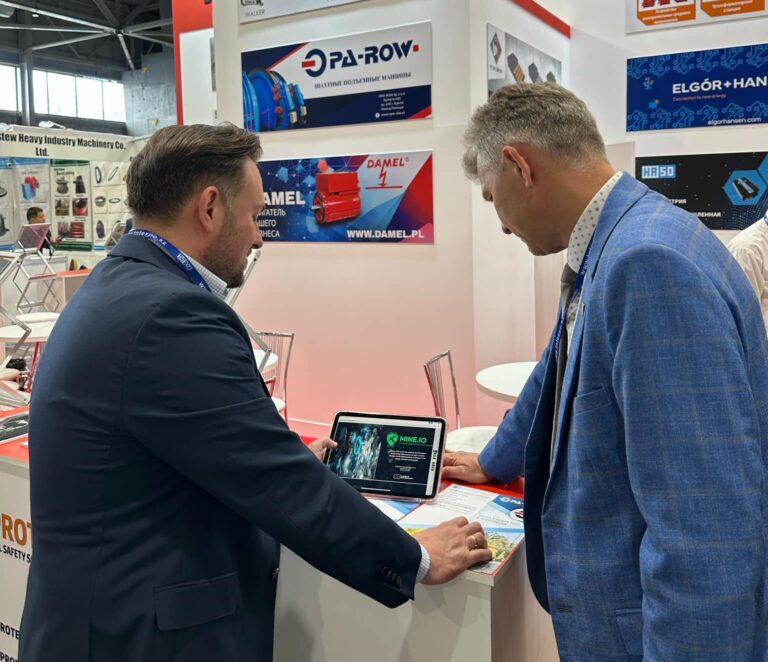
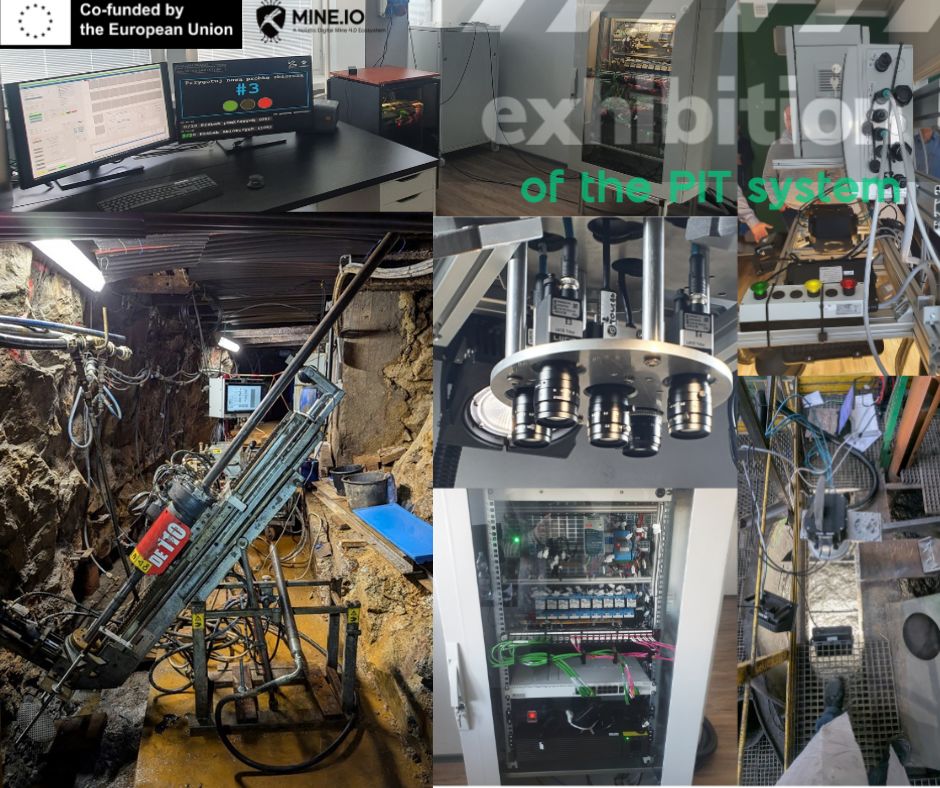
More than a conceptual discussion, the session functioned as a technology exhibition, where multiple pilot demonstrators illustrated how AI‑driven solutions, advanced sensors and digital systems can transform real mining processes.
From Automation to Intelligence
A key takeaway message of the session was that automation alone is no longer sufficient.
Modern mining requires systems that are not only automated, but also:
- data‑driven,
- adaptive,
- and capable of learning from operational conditions.
Across the presented pilot demonstrations, this shift was clearly visible — from traditional process control toward intelligent, AI‑supported decision‑making embedded directly in operations.
Digitalisation at the Source: Smart Drilling Systems
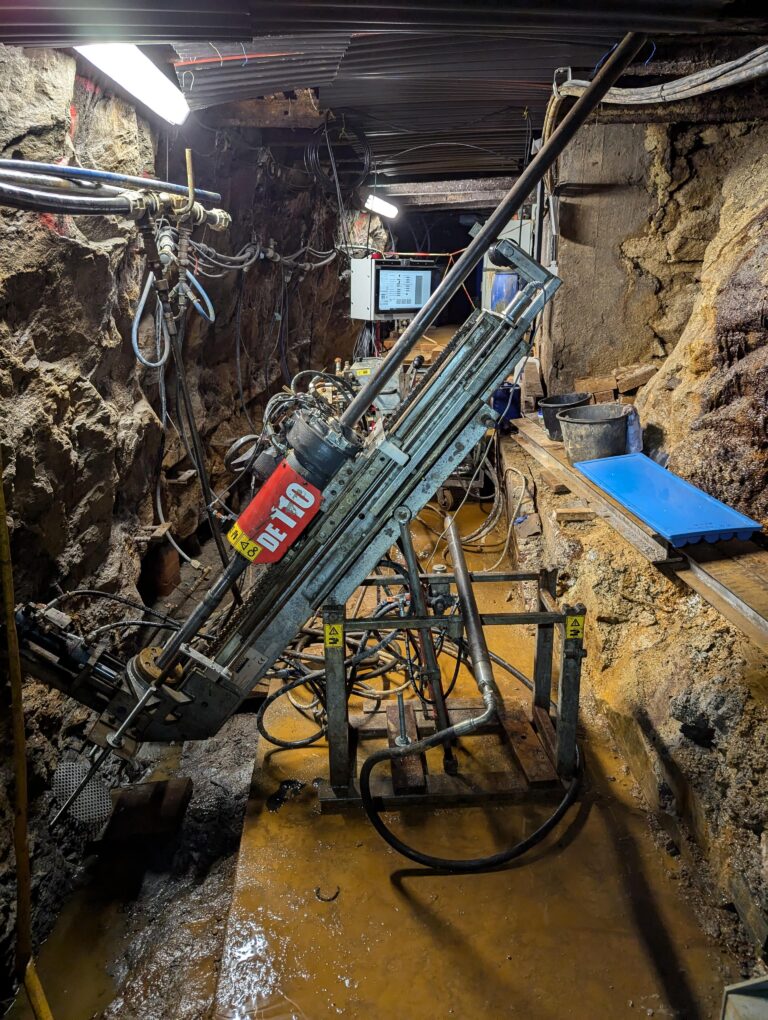
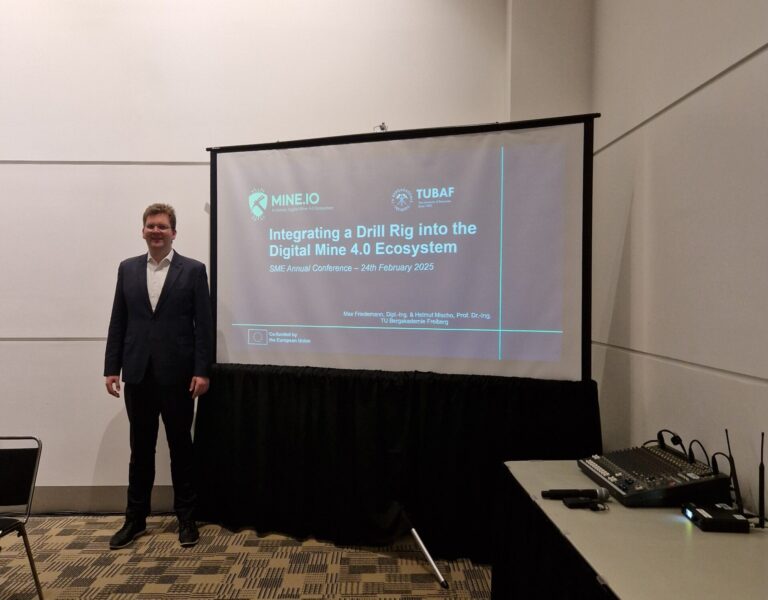
One of the key pilot demonstrators focused on the digitalisation of drilling operations, showing how even existing equipment can be transformed into intelligent systems.
In this pilot, a conventional drill rig was upgraded with:
- advanced sensor systems (acceleration, pressure, temperature, rotation),
- real‑time data acquisition and transmission,
- integrated dashboards for operators.
This enabled continuous monitoring of drilling conditions and provided:
- real‑time feedback to operators,
- improved process efficiency,
- faster learning for less experienced personnel.
Crucially, the demonstrator also introduced AI‑supported analysis of drilling data, allowing:
- identification of geological boundaries,
- evaluation of rock properties,
- detection of drill bit wear.
👉 This represents a key step toward embedding intelligence directly at the operational level.
Predictive Maintenance as a Core Capability
Another important demonstrator showcased AI‑based predictive maintenance, which plays a central role in smart mining operations.
Using machine learning techniques — including automated machine learning and deep learning — the system is able to:
- detect anomalies in equipment behaviour,
- estimate current degradation levels,
- predict future equipment condition,
- recommend maintenance actions.
👉 Instead of reacting to failures, operations can move toward proactive and optimised maintenance strategies, reducing downtime and extending asset lifetime.
From Laboratory to Field: X‑ray Based Ore Analysis and Sorting
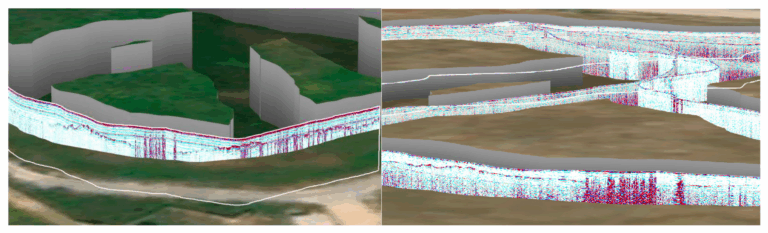
The session also presented demonstrators focused on material characterisation and ore processing, particularly using advanced X‑ray technologies.
Two complementary approaches were demonstrated:
- X‑ray computed tomography (XCT) – providing visualisation of internal structures,
- Energy‑dispersive X‑ray diffraction (ED‑XRD) – enabling direct mineral identification.
These technologies allow:
- non‑destructive analysis of drill cores,
- faster and more automated processing compared to laboratory assays,
- field‑deployable solutions for exploration workflows.
In addition, sensor‑based ore sorting demonstrators, supported by AI and dual‑energy X‑ray transmission, illustrated how:
- ore and waste can be separated early in the process,
- resource efficiency can be significantly improved,
- energy and water consumption can be reduced.
👉 These demonstrators highlight a critical shift: from bulk processing → to selective, data‑driven material handling.
Learn more about the three technology groups highlighted above in our dedicated articles
AI‑Driven Flotation: From Monitoring to Control
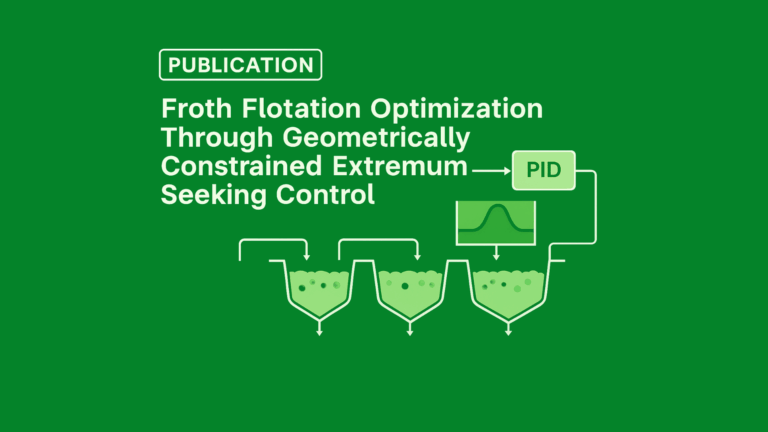
One of the most advanced pilot demonstrations presented during the session focused on AI‑powered control of the flotation process, a complex and critical stage of ore beneficiation.
The demonstrator, implemented by a consortium of industrial and research partners, integrates:
- real‑time image acquisition of flotation froth,
- process parameters and environmental data,
- machine learning models analysing froth characteristics.
Using neural networks trained on operational data, the system is able to:
- estimate metal content in real time ((tested in this demonstrator on copper ore flotation processes),
- monitor process stability and efficiency,
- support optimisation of flotation parameters.
👉 This transforms flotation from a largely operator‑dependent process into a data‑driven, continuously optimised system.
Learn more about this solution in our dedicated article below
Digital Smelter: Toward Autonomous Metallurgical Processes
The session also included a demonstrator addressing downstream processing: the digital smelter.
Here, advanced sensors and control systems enable:
- real‑time monitoring of temperature, gas composition and process conditions,
- integration with digital twins for process simulation,
- optimisation of metallurgical reactions and flows.
The use of digital twins allows:
- prediction of process behaviour,
- optimisation of resource use,
- improved recovery of valuable materials and energy efficiency.
👉 This demonstrates how digitalisation extends beyond upstream operations into full process chain optimisation.
Integration Across the Value Chain
A key takeaway from the session is that these demonstrators are not isolated technologies.
They collectively illustrate how Mine.io supports the development of an integrated digital mining ecosystem, where:
- data flows across processes (from drilling to processing),
- AI models support decision‑making at multiple stages,
- operations become increasingly connected and adaptive.
👉 In this context, the pilot demonstrators and technology exhibitions presented during the event show how individual components contribute to a coherent, scalable system.
Session Insights
The discussion following the session highlighted several important aspects for future deployment:
- integrating legacy equipment remains a critical challenge,
- access to high‑quality operational data is essential for AI applications,
- modular and scalable approaches enable gradual adoption,
- operator acceptance and usability are key for real‑world implementation.
These insights confirm that the transition toward smart mining is not only technological, but also organisational and operational.
Watch the Session & Explore Materials
🎥 Final Event Recap: Session 2 | Pilot Demonstrators I – Smart & Automated Operations
https://youtu.be/94ik8-LpCEM
Next in the Series
This session clearly demonstrated that Smart & Automated Operations are no longer a vision, but a set of concrete, validated pilot implementations.
In the next article, we will explore how Mine.io advances this transformation further through Autonomous & Electrified Operations, focusing on robotics, electrification and future mining mobility.