Mine.io Final Event Recap – Chapter 1: From Vision to a Digital Mining Ecosystem
The Mine.io Final Event, held on May 7th, 2026 in Turin, marked the culmination of a multi‑year Horizon Europe effort to define and validate a new paradigm for mining: a Digitally Integrated, Safe and Sustainable Digital Mine 4.0.
The event brought together project partners, industry representatives and stakeholders to present not only project results, but a complete framework for the digital transformation of mining — moving from vision, through validation, toward real‑world deployment.
As outlined during the opening session, the objective of Mine.io was not simply to develop isolated digital solutions, but to build a holistic digital ecosystem covering the entire mining value chain, from exploration to post‑mining activities.
This perspective defines the logic of both the Final Event and this first session recap.
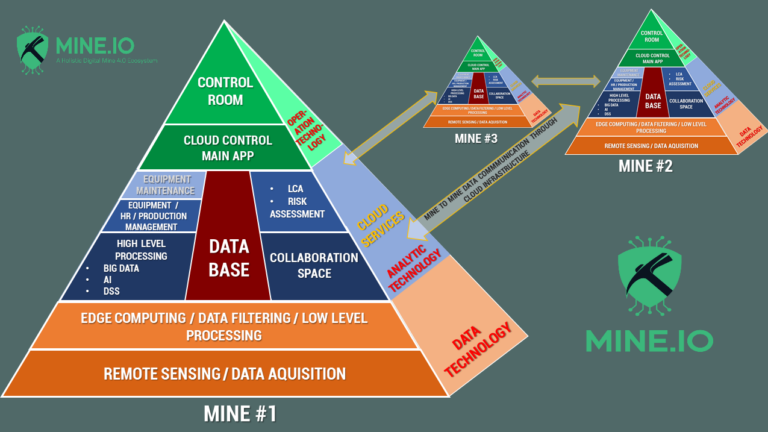
From Vision to Architecture: The Core of Mine.io
During the opening session, it was clearly emphasized that Mine‑io is built on a systemic concept of mining digitalisation, integrating:
- data-driven decision-making,
- automation and AI,
- interoperability across systems and sites,
- sustainability and circular economy principles.
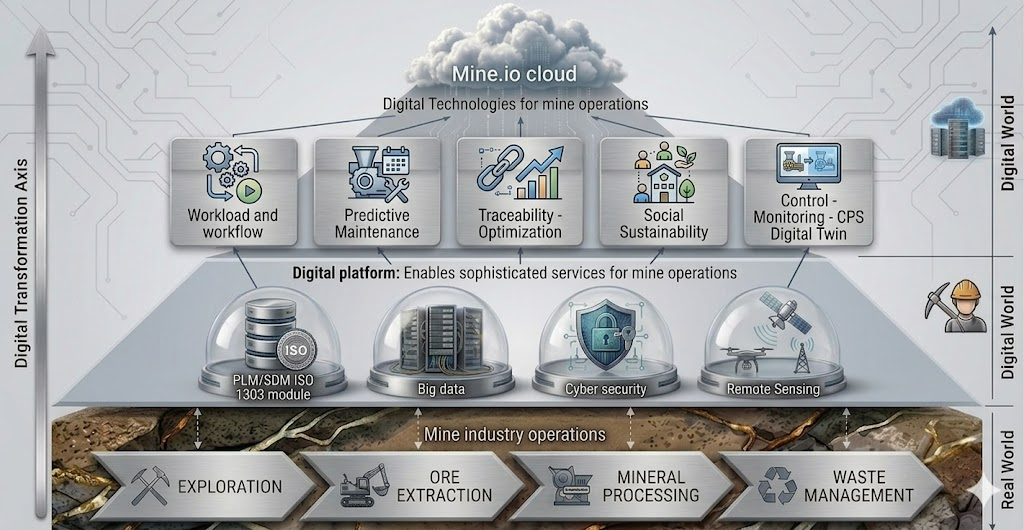
Crucially, this vision is realised through a single foundational element: the Mine.io Digital Architecture and Framework.
All pilot demonstrations presented during the event — from AI‑driven processing to environmental monitoring — are not standalone innovations.
They are pilot implementations of selected elements of this architecture in different operational contexts
👉 In other words:
The architecture is not one component of the project — it is the core result around which all other results were developed and validated.
The Problem: Fragmented and Non‑Interoperable Mining Systems
As highlighted during the Architecture session, modern mining operations still suffer from fundamental structural challenges:
- fragmented and siloed data across sites and systems,
- low interoperability between equipment and platforms,
- limited integration between operational and analytical layers,
- lack of unified data governance and real‑time processing capabilities.
Even when data exists, it is often:
- isolated,
- not standardised,
- not usable for advanced analytics or automation.
This creates a structural barrier to digital transformation.
The Solution: A Holistic Digital Mine 4.0 Framework
The Mine.io response to this challenge is a layered, modular and interoperable digital architecture, designed to:
- integrate heterogeneous systems and data sources,
- enable real‑time and historical data processing,
- support AI‑driven services and automation,
- provide a scalable digital backbone for mining operations.
This architecture is formalised as the Mine.io High‑Level Reference Architecture (HLRA) — introduced and structured during the Architecture session.
Mine‑io Architecture: Core Components
1. Mine Physical Operations Layer – Where Data Is Generated
This layer represents the physical reality of mining operations.
It includes:
- exploration, extraction, processing and waste management,
- industrial systems (e.g. drill rigs, furnaces, conveyors),
- sensors, IoT devices, robotics, UAVs and autonomous systems,
- field-level data acquisition and control systems.
During the session, it was emphasised that: 👉 digital transformation must start from real operational data at source
This layer ensures:
- data accuracy,
- real-time availability,
- connection between physical processes and digital systems.
2. Mine.io Platform Layer – The Digital Backbone
This is the core layer of the entire Mine.io framework, where integration happens.
It is built around the Mine.io Big Data Platform and enables the transition from fragmented systems to a unified digital ecosystem.
🔹 Edge Computing & Data Pipelines
- real-time data acquisition directly from equipment and sensors,
- operation in environments with limited connectivity,
- separation of streaming, batch and large‑volume data flows,
- integration of pilot-level systems into a unified pipeline.
👉 This ensures that data flows continuously from the mine to analytical systems.
🔹 Data Storage & Data Management
- scalable storage for heterogeneous data types (e.g. sensor, image, 2D/3D, process data),
- support for both real-time and historical datasets,
- indexing, querying and dynamic data orchestration,
- management of large volumes of distributed data.
👉 The key shift here is: from isolated datasets → to structured, searchable and usable data ecosystems
🔹 Interoperability & Standardised Data Models
- integration based on ISO 10303 (PLM) standards,
- centralised repository for product and system data,
- REST APIs enabling machine‑to‑machine communication,
- unified data exchange across heterogeneous systems.
During the session, interoperability was highlighted as: 👉 a prerequisite for any scalable digital mining solution
🔹 Security & Governance
- identity and access management across users, machines and systems,
- secure communication and authentication mechanisms,
- governance ensuring control, compliance and data integrity,
- security‑by‑design approach across all layers.
👉 This aspect is critical in industrial environments where:
- systems are distributed,
- data is sensitive,
- operations must remain resilient.
3. Services & Applications Layer – From Data to Decisions
This layer transforms raw data into operational value.
It includes tools like:
- AI and machine learning models,
- predictive maintenance and optimisation tools,
- workflow automation,
- digital twins,
- environmental and sustainability monitoring,
- visualisation, dashboards and reporting tools.
👉 This is where: data becomes decisions
End‑to‑End Integration: The Key Innovation
The Architecture session clearly demonstrated that Mine.io is not just a data platform — it is an end‑to‑end system:
- from physical operations (edge),
- through integration and data management (platform),
- to advanced analytics and decision support (services).
This enables:
- real-time monitoring and optimisation,
- predictive and AI-driven operations,
- integration across sites and pilots,
- scalability beyond individual use cases.
Architecture as the Foundation of Pilots
A key message from the session — also visible across the entire Final Event — is that:
👉 the pilot demonstrations were developed based on selected elements of this architecture and showcase specific technological processes in practice
This includes:
- AI‑enabled predictive and preventive maintenance together with AI‑driven flotation (processing),
- digital twins and automation,
- electrification and autonomous systems,
- environmental monitoring and waste management.
Without the architecture: 👉 these solutions would remain isolated.
With the architecture: 👉 they become part of a coherent digital mining ecosystem.
Session Insights – Questions and Discussion
The discussion following the Architecture session highlighted several critical implementation aspects:
- integrating legacy mining systems into modern digital frameworks remains a key challenge,
- interoperability standards are essential for scaling beyond pilot environments,
- modular architectures enable gradual adoption rather than disruptive transformation,
- security and governance must be treated as core design elements, not add-ons.
These insights reinforce a central point:
👉 digital transformation in mining is not only about technology — it is about structured system integration
Watch the Session & Explore Materials
🎥 Mine.io Architecture Session (Final Event)
https://youtu.be/0WHtHksOYG0?si=mF60xTKM12NQX3rv
📊 See other related articles:
https://mineio-horizon.eu/category/progressworkcampaign/
🌍 See a summary of the event on the project’s dedicated webpage: