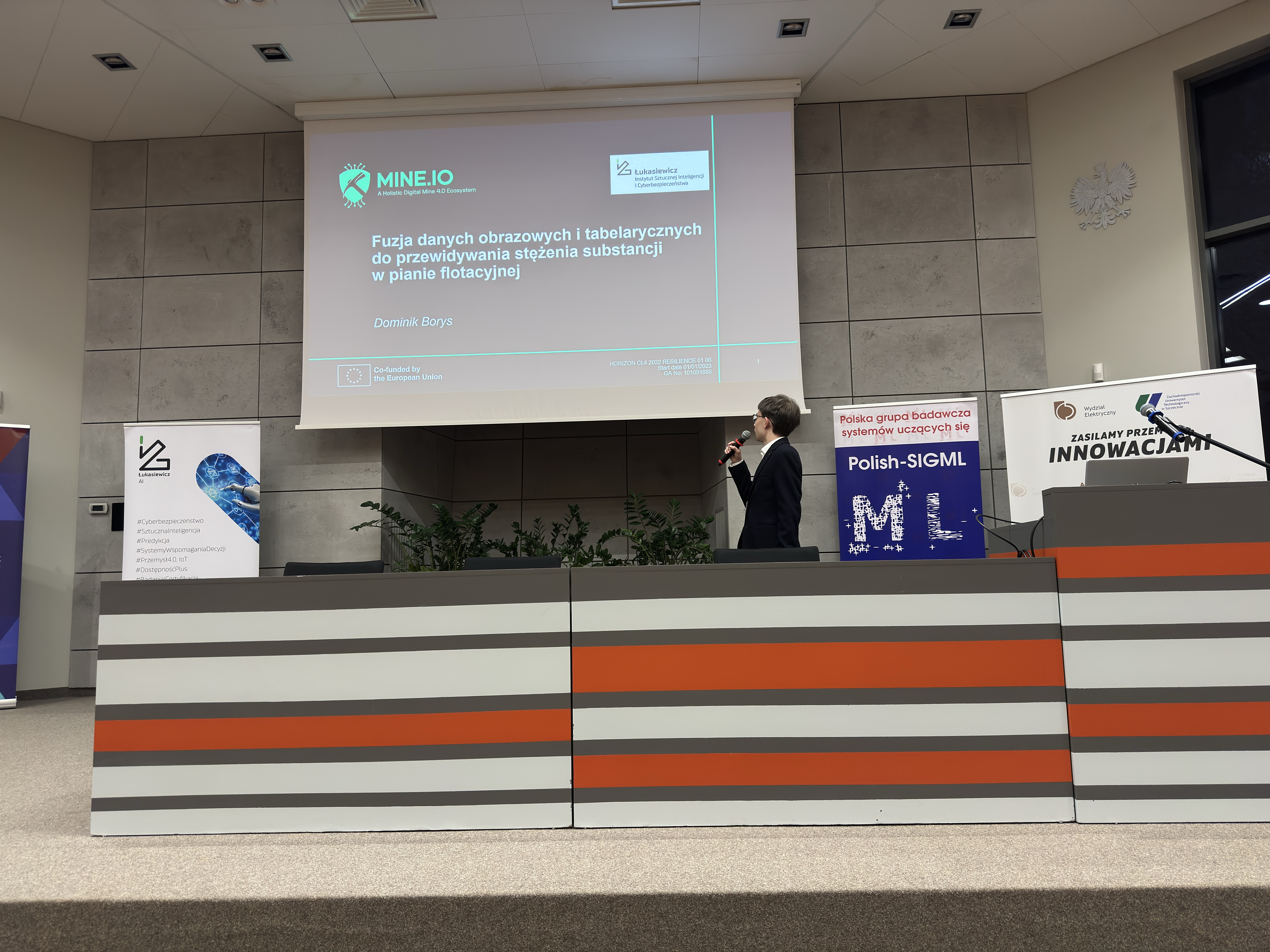
Mine.io Partners at the XI Meeting of the Polish Research Group on Machine Learning Systems (PL-SIGML)
On 27–28 November 2025, the city of Szczecin hosted the XI Meeting of the Polish Research Group on Learning Systems (PL-SIGML), accompanied by the Seminar of the Informatics and Automation Commission of the Poznań Branch of the Polish Academy of Sciences. The event brought together experts from leading scientific centers across Poland, creating an important forum for exchanging knowledge and experience in machine learning, computer vision, and robotics.
Event Highlights
The two-day program featured numerous presentations covering topics such as:
- neurosymbolic architectures,
- the use of language models in CTI report analysis,
- digital twins in medicine,
- image recognition methods,
- data integration in robotic applications.
This year’s edition, held at the Auditorium of Prof. Stanisław Skoczowski at the Faculty of Electrical Engineering of the West Pomeranian University of Technology in Szczecin, focused on the theme:
“Machine Learning for Computer Vision and Robotics.”
Contribution of Mine.io Partners
Special recognition was given to participants of the Łukasiewicz – AI special session and the joint session with the Informatics and Automation Commission of the Polish Academy of Sciences. Among the speakers was Dominik Borys from the Łukasiewicz – AI Institute, who delivered a presentation entitled:
“Fusion of image and tabular data for predicting substance concentration in flotation froth.”
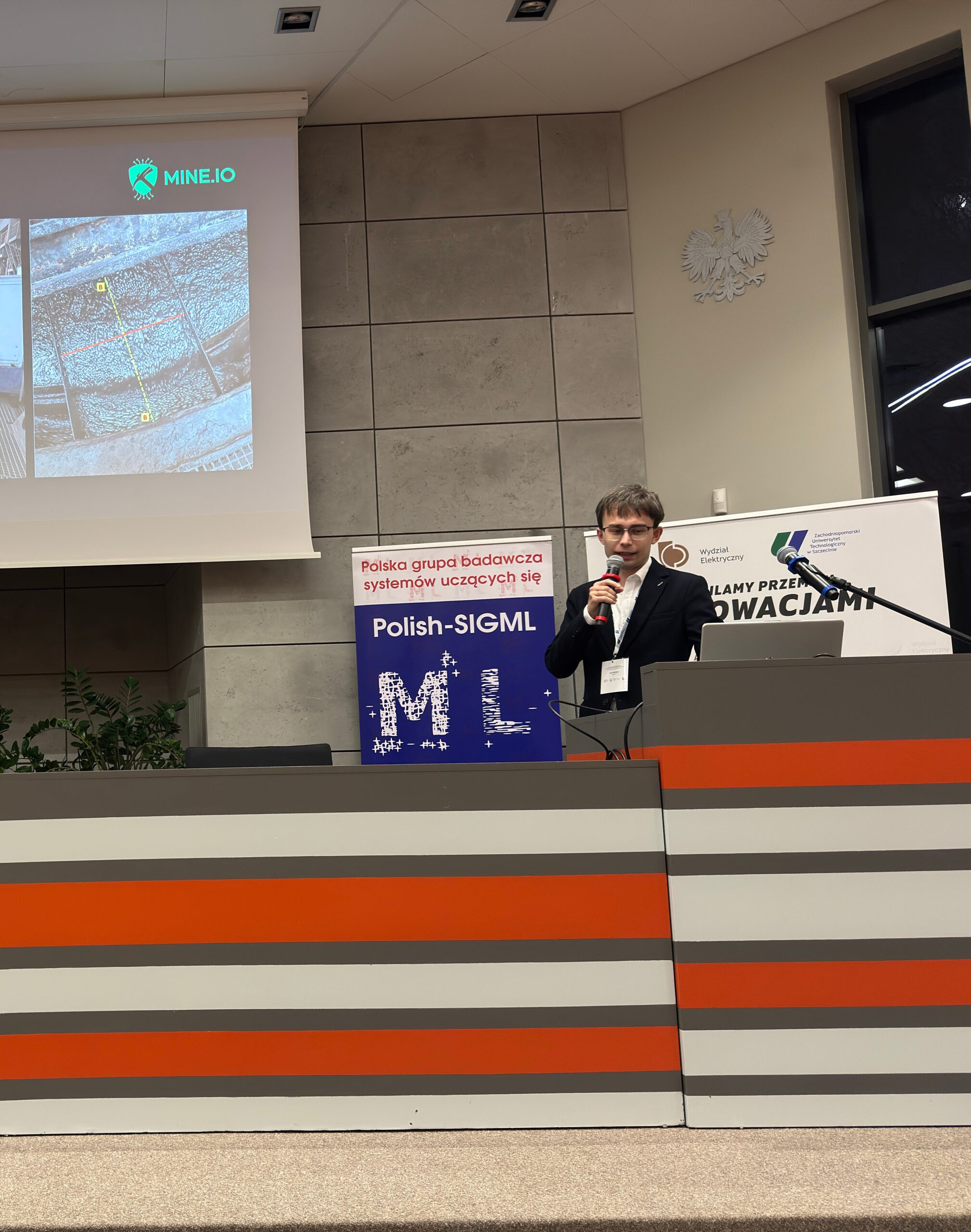
The talk showcased the results of research and development conducted within task T3.4 “Artificial Intelligence technology for monitoring, control of metal ore processing” of the Mine.io project, carried out by a Mine.io team including Łukasiewicz – AI, Łukasiewicz – ITR, KGHM, and AGH.
Innovations in Mine.io
The work focuses on developing a photonics–informatics system (PIT) for monitoring the flotation process and analyzing copper content in flotation froth. Within the project:
- a PIT system was designed and pilot-implemented in an industrial flotation environment,
- advanced AI-based image registration and analysis technologies were integrated,
- machine learning (ML) algorithms were applied to correlate froth image data with metal content.
You can read more about Mine.io’s achievements in this area in the article: “AI-Powered Flotation Optimization with a Polish Pilot at KGHM”
Future Outlook
Such systems will ultimately enable:
- optimization of technological and economic parameters of flotation,
- improved monitoring of metal recovery from ore,
- reduction of metal losses in waste.
Watch a short film report from the laboratory demonstration and historical implementation work on a real site at KGHM.